Most AI
fails quietly
The assistant runs, the output lands and nobody acts on it. FLAIR is the operating framework for making AI hold. Score your organisation in five minutes and see what is holding it back.
Five pillars. Five minutes. No sign-up needed to see your result.
Created by:
Richard Wood
Adam Aigbokhae
Aimane Ben M Hand
From experiments to infrastructure
FLAIR came out of client work. It's been applied, stress tested and adapted over years of working across engagements, from professional services firms of around a hundred people to technology businesses in the low thousands, in the UK, Ireland, the Netherlands, Canada and the United States. It was created by operators, not theorists.
What five minutes gets you
You score five pillars from 0 to 5 against descriptions taken from the book. The result gives you a stage, the pillar holding everything else back and a first move.
Run the ScorecardBinding constraint: Foundation.
See the whole worked examplePilots do not become capability by themselves
AI rarely stalls because an organisation lacks ideas. It stalls because the conditions around those ideas are not ready.
Tools get chosen before priorities. Assistants launch without ownership. Early wins multiply into disconnected experiments, while trust, maintenance and measurable value arrive too late.
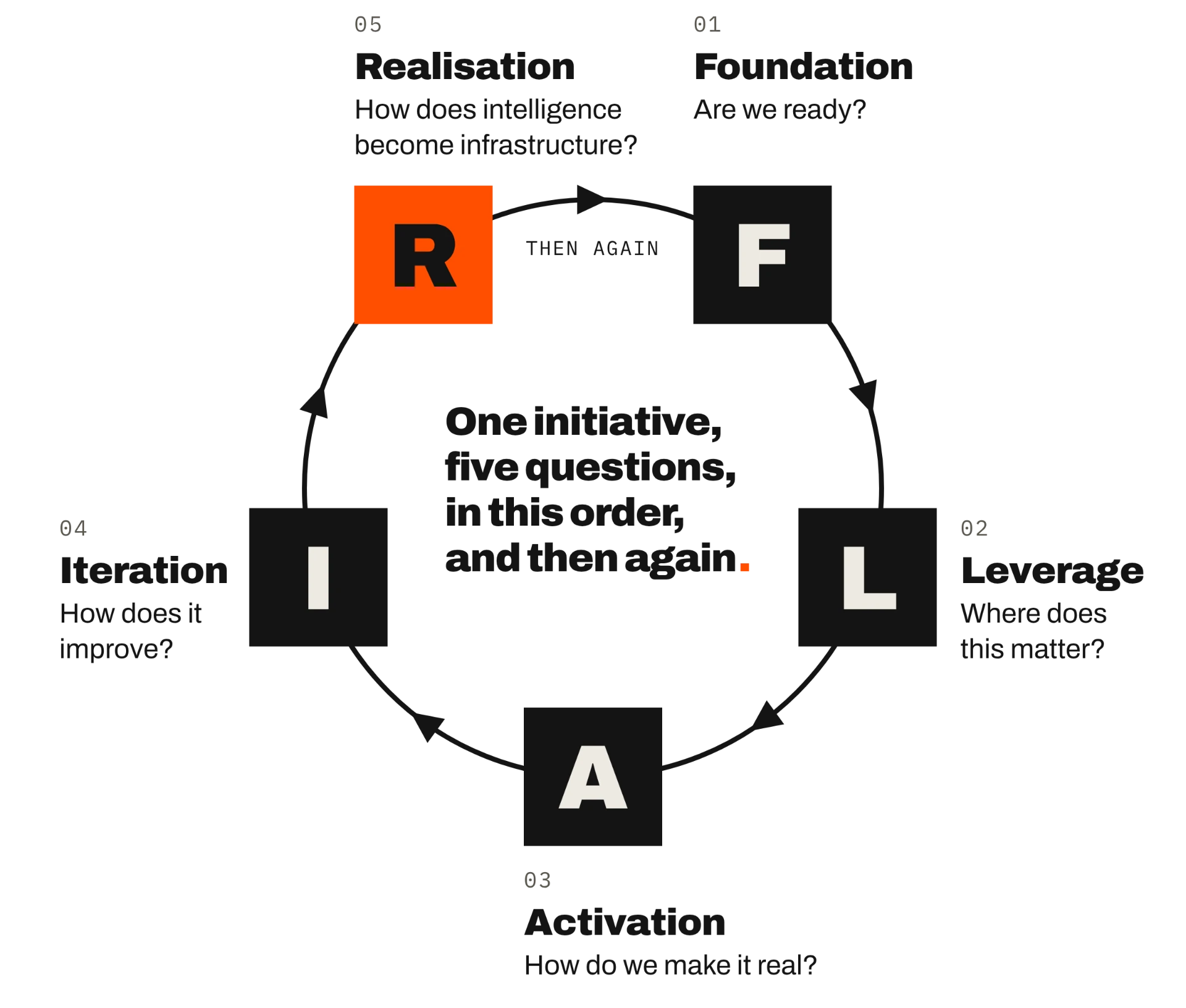
FLAIR puts those decisions into an order. It connects readiness, prioritisation, delivery, improvement and adoption as one repeating operating cycle.
- Foundation
- Are we ready?
- Leverage
- Where does this matter?
- Activation
- How do we make it real?
- Iteration
- How does it improve?
- Realisation
- How does it become infrastructure?
For the person who has to answer for the AI programme
Assistants are live and you cannot say with confidence which ones are being used.
The board asks what the programme has returned and the only number you have is time saved.
The next build is on the table and nothing tells you whether the conditions are in place to hold it.
Practical tools for every phase
FLAIR is becoming a working toolset, not just a model.
Start with the Scorecard to see your current stage, identify the pillar holding you back and find the next move. Find every tool and its availability in the tools directory.
One-Page AI Plan
One page, from the business to the work. Free to use. Register only to save.
Start your PlanPrioritisation Matrix
Score every candidate on Impact, Ease and Readiness. Free with registration.
Open the MatrixAI statistic check
Five questions before a number goes in a board pack. Free with registration.
Check a statisticFrom Hype to Habit

The operating manual behind FLAIR.
The book explains the five phases, the order they belong in and the practical disciplines that help AI become part of how an organisation works.
Common questions about FLAIR
What is the FLAIR framework?
FLAIR is an operating framework for making AI hold. It helps organisations move AI from isolated experiments into useful, governed and lasting ways of working, by connecting readiness, prioritisation, delivery, improvement and adoption as one repeating operating cycle.
What does FLAIR stand for?
Foundation, Leverage, Activation, Iteration and Realisation. Each phase answers one question: Are we ready? Where does this matter? How do we make it real? How does it improve? How does it become infrastructure?
Why do the phases have to be followed in order?
Each phase depends on the one before it. Skip Foundation, and Leverage becomes guesswork. Skip Leverage, and Activation becomes proliferation. Skipping ahead does not save time.
Who is FLAIR for?
The person who has to answer for the AI programme: leaders who have shipped assistants, report on what the programme has returned, or are about to fund the next build.
Where does FLAIR come from?
FLAIR came out of client work, from professional services firms of around a hundred people to technology businesses in the low thousands, in the UK, Ireland, the Netherlands, Canada and the United States. It was created by Richard Wood, Adam Aigbokhae and Aimane Ben M Hand.
What does the FLAIR Scorecard tell me?
You score five pillars from 0 to 5 against descriptions taken from the book. The result gives you a stage, the pillar holding everything else back and a first move. It takes about five minutes, and no sign-up is needed to see your result.
Which FLAIR tools are available?
The tools directory lists the FLAIR Scorecard, One-Page AI Plan and the tools for prioritisation, building, review, measurement, governance and adoption. The Scorecard and One-Page AI Plan are free to use without registration; enter your information only to save. Other open tools are free with registration.
Find out what is holding your AI back
Five pillars. Five minutes. No sign-up needed to see your result.